





Last update 2025-11-20
Dietl Square is the heart of spa Szczawnica—a place where history meets the atmosphere of a resort. Since the 19th century, it has been the central point of cultural, therapeutic, and social life. This is where the first villas, drinking halls, and the spa chapel were built, giving the square its unique character.
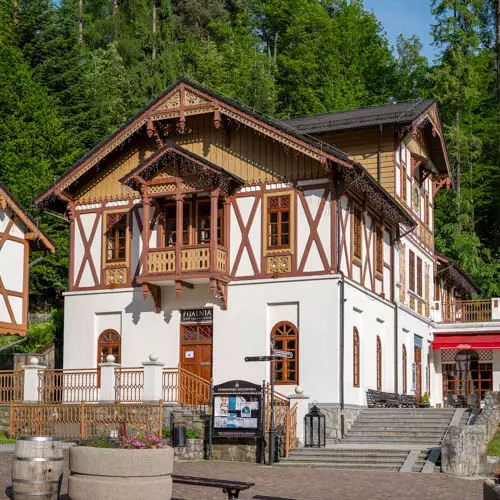
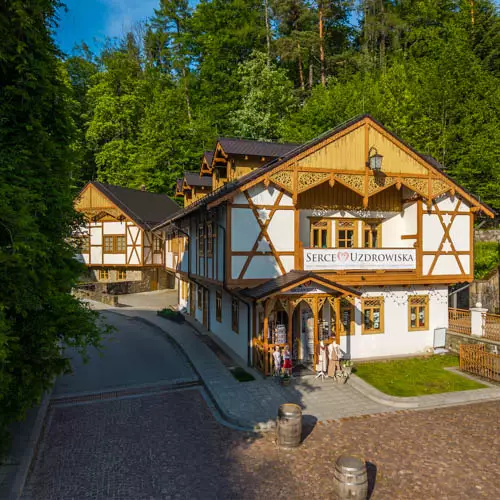
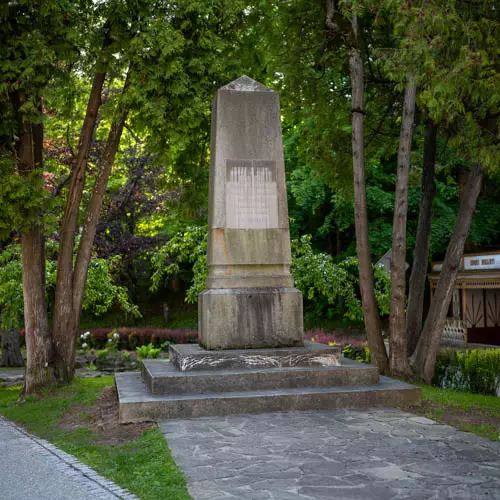
Dietl Square is located in the central part of the Szczawnica spa, just above the main part of the town, at the foot of Park Górny. The name of the square comes from the obelisk at its entrance, dedicated to Józef Dietl, and was officially introduced only after World War II. Previously, it was known as the Szczawnica Market Square, a place for public gatherings where highlander women sold dairy products and forest fruits on market days.The square was shaped before 1853 by filling in the bed of the Szczawny Stream. The buildings around Dietl Square were designed in the Swiss-Tyrolean style by Józef Szalay and were constructed between 1850 and 1867.
The obelisk commemorates Józef Dietl (1804–1878)—a physician, professor and rector of the Jagiellonian University, founder and member of the Academy of Learning, balneologist, promoter of Polish spas, mayor of Kraków, and ardent Polish patriot. He was also a longtime friend of Szalay, the one who called Szczawnica “the pearl of national spas.” The monument was unveiled on August 29, 1865.
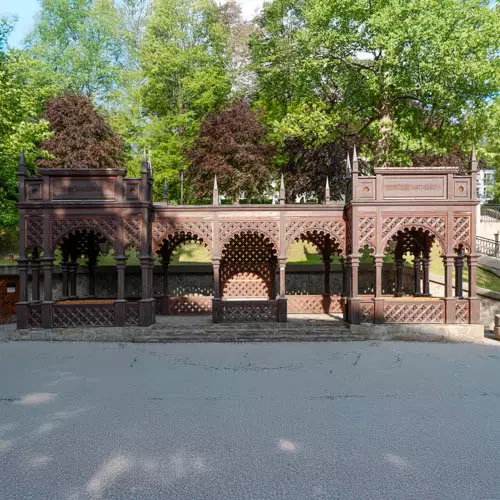
Right at the entrance to Dietl Square, on the left side, stands the now-closed “Waleria” drinking hall. The spring was discovered in 1840 and named after the wife of the spa physician Onufry Trembecki. Initially, it was enclosed in an artificial grotto in the Romantic style, a cave tastefully arranged from all kinds of local stones, later replaced by an iron pavilion. In 1897, a gallery for the orchestra was added above it. After 1945, the water was no longer used due to soil contamination and low yield.
The western side of the square is opened by the house known as the “Old Office.” It was one of the first spa buildings and housed the manager’s apartment as well as the office of the Upper Spa. The row of service points originally formed a covered wooden promenade, built in 1864, intended for spa visitors seeking shelter from rain and heat. During the interwar period, Adam Stadnicki ordered it to be rebuilt into a row of pavilions and small shops.
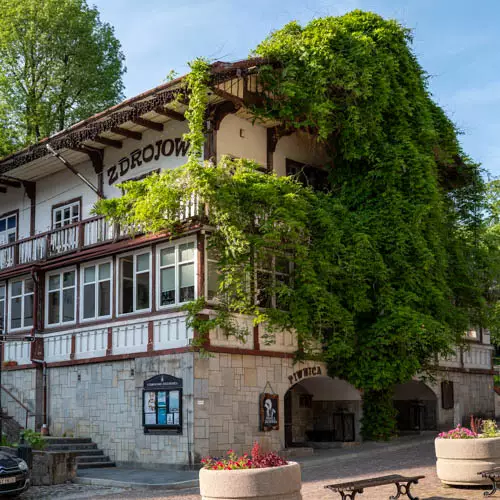
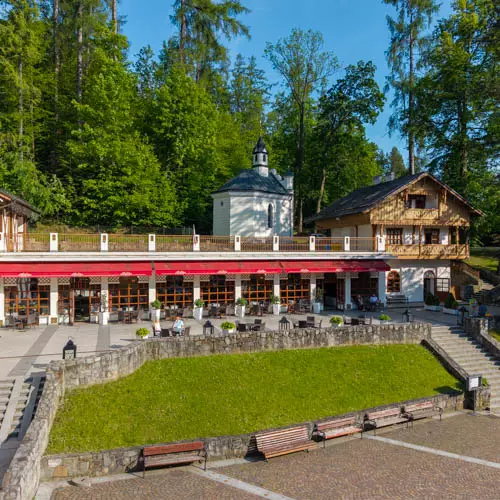
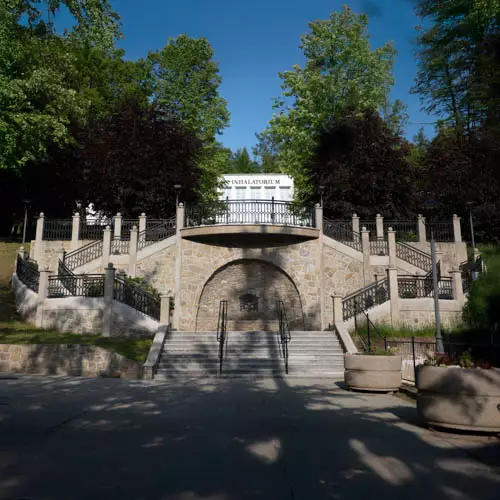
Standing on the upper terrace, the villa “Pałac” was constructed between 1864 and 1866. Its southern wing was crowned with a clock tower. The building provided guest apartments. In the 1920s, it was remodeled: the main entrance was placed centrally, and wide stairs were added from the base of the square. However, these were removed during another modernization in 1972. After the war, the “Zdrojowa” restaurant was opened here, and from 1972 to 2014, the villa housed the collections of the Józef Szalay Pieniny Museum.
The western wall of the square is closed by the house “Pod Bogarodzicą,” built in 1853 as a guesthouse. In the central part of the upper floor façade, a niche contained a figure of the Mother of God (later moved to the southern corner during renovations, and eventually removed entirely). In 1890, part of the upper floor was adapted into an Inhalation Center run by Dr. Michał Janocha from Rzeszów. By the late 1920s, the building contained baths where mineral water treatments from the “Jan” spring were prepared. From that time, the house was often referred to as the “Baths.” After the war, it operated as a Hydrotherapy Center, which was closed in 1975 following the opening of the new Natural Therapy House on Zdrojowa Street.
On the northern frontage stand two buildings—the villa “Holenderka” and the “House over the Springs,” which served as the drinking hall for Szczawnica’s mineral waters.
The villa “Holenderka” was built in 1855. The upper floor contained a three-room apartment with a balcony, while the ground floor housed a room with an alcove and a kitchen. The ground floor walls were made of stone, and the second floor was built in half-timbered construction. From 1896, the villa housed the spa office. Thanks to its central location, for many years it was also the place where spa physicians practiced. In 2008 it was restored to its historical form.
The “House over the Springs” was built in 1863. It was the first building erected over the “Stefan” and “Józefina” springs, replacing a neoclassical pavilion where water was drawn with glasses tied to wooden rods. In 1897, two wall paintings were added to the upper floor façade, depicting St. Kinga, patroness of the Pieniny, and St. Barbara, patroness of mines and spas.
The building served many functions. Most importantly, it housed the main drinking hall, where highlander girls known as “podawajki” served water. Next to it was a room called the resting lounge and a reading room, where the spa orchestra played in bad weather. The upper floor contained eight guest rooms, and the building also included a “żętycarnia,” where żętyca (fermented sheep’s milk whey) was served mixed with mineral water.
Between 1931 and 1934, Count Adam Stadnicki modernized the building. The drinking hall gained a modern, functional interior filled with glass and aluminum. From 1984, it was closed, and water was served nearby in the café “Haneczka.” In 2002, the building was destroyed by fire. In 2006 it was demolished, and in 2008 it was reconstructed in its historical form.
The eastern side of the square consists of two buildings—the “Helenka” café adjoining the drinking hall and directly connected with it, the villa “Szwajcarka,” as well as the spa chapel standing on the upper terrace.
The “Helenka” café, built in 2008, refers to the former elegant promenade gallery for spa visitors drinking water, erected between 1857 and 1858. Around 1960, a pavilion housing a café named “Haneczka” was built in its place. In the 1980s, a mineral water drinking hall operated there.
The villa “Szwajcarka Górna” was built in 1852. For many years, it housed the office of the spa physician Onufry Trembecki. Until the 1860s, it also contained the post office. In the villa’s ground floor, there was a sales point for glass mugs with ounce markings. In the summer of 1902, the poet Kazimierz Przerwa-Tetmajer stayed in “Szwajcarka.”
The neo-Gothic spa chapel was designed by Józef Szalay and built between 1844 and 1847. Its solemn consecration took place on July 29, 1847, under the invocation of the Queen of Heaven, with the service conducted by Rev. Maciej Szafrański, the dean of Łącko. The authorship of the altar painting is attributed either to Józef Szalay or to Konrad Coghen. Inside are three marble plaques. Two of them are dedicated to Stefan and Józefina Szalay, funded by Józef, while the third, dedicated to Józef Szalay, was funded by Dr. Onufry Trembecki. Between 2006 and 2008, the chapel was restored.
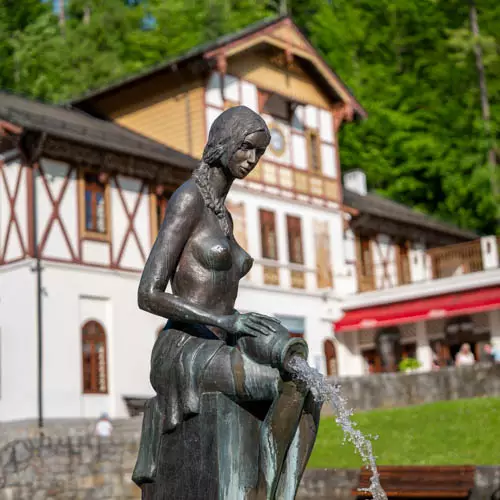
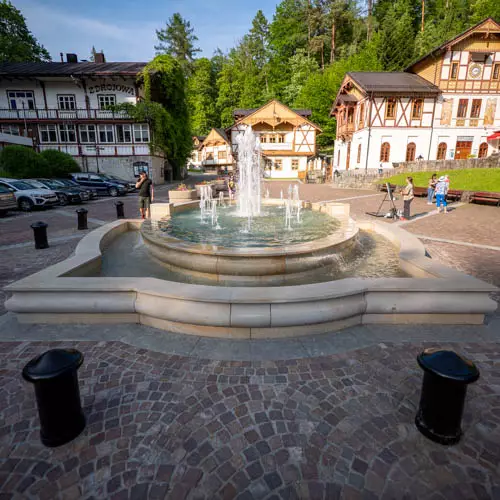
The central part of Dietl Square is occupied by a fountain from 2012, featuring a bronze sculpture by Michał Batkiewicz. It stands on the site where, in 1865, Szalay installed a water feature and erected a mast on which a flag was flown during celebrations. In the interwar period, the water feature received a stylized concrete frame, and in 1957 a reinforced concrete statue, “Woman with a Jug,” by Stanisław Marcinów, was placed on it.